
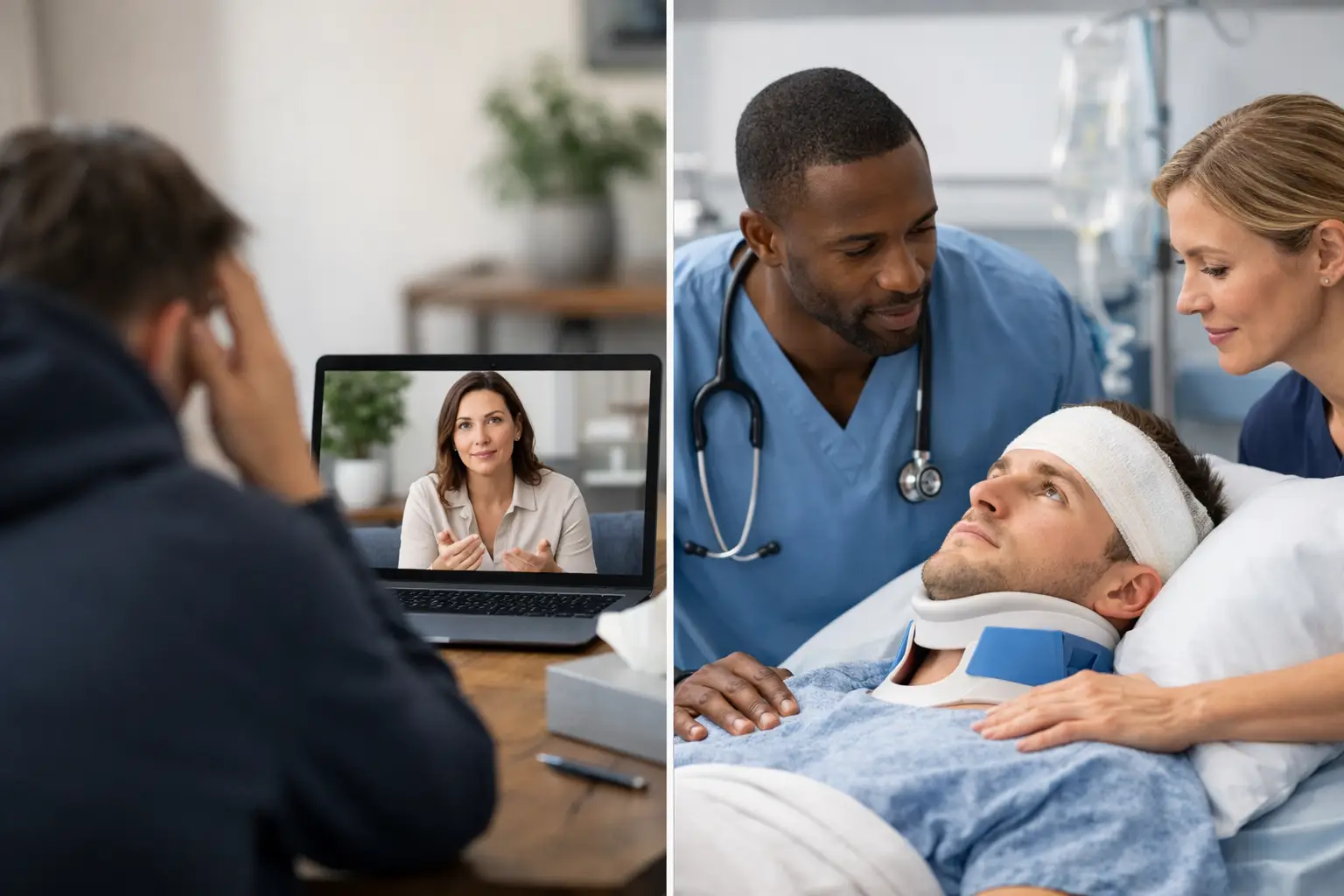
When someone is spiraling at 2:00 a.m. after a rocket siren, an ambush, or a funeral, the debate around telehealth vs in person trauma care stops being theoretical. The real question is simpler and harder: what can reach this person fast enough to stabilize them, protect function, and keep the injury from deepening? In trauma care, speed matters. Access matters. Trust matters. The right answer is rarely ideological. It is operational.
For supporters who care about measurable impact, this matters because trauma does not wait for clinic hours, transportation, childcare, reserve duty schedules, or geographic convenience. A treatment model can be clinically sound on paper and still fail if the patient cannot get to it. That is why telehealth has become a serious force multiplier in trauma recovery, especially in high-threat environments. But it is not a replacement for every kind of care, every patient, or every phase of recovery.
Telehealth vs in person trauma care is really a question of access and fit
Trauma treatment works best when it is timely, consistent, and matched to the patient’s symptoms and circumstances. Telehealth expands reach. In-person care expands sensory and clinical depth. Both can be decisive. Both can fall short.
Telehealth can remove the delays that often turn acute stress into something more entrenched. A patient in a border community, a displaced family in temporary housing, or a reservist juggling activation and home life may be able to connect with a clinician in hours instead of waiting weeks. That speed is not cosmetic. Early intervention can reduce symptom escalation, improve follow-through, and keep people connected to care while they are still willing to engage.
In-person trauma care, however, offers something digital treatment cannot fully replicate. A clinician in the room can pick up on subtle body language, dissociation, agitation, hygiene changes, motor slowing, and environmental cues that may not show up clearly on a screen. For some patients, especially those with severe dysregulation, psychosis, active substance misuse, or high suicide risk, physical presence is not just preferable. It may be necessary.
The strongest trauma systems do not treat this as a culture war between old and new methods. They build both lanes and move patients through the right one quickly.
Where telehealth trauma care is strongest
Telehealth performs best when the barrier is not willingness, but logistics. That includes distance, mobility limits, caregiving burdens, stigma, schedule instability, and security threats that make travel difficult or unsafe. For many people, the option to speak with a trauma-informed therapist or psychiatric provider from home is what makes treatment possible at all.
It also helps with continuity. Trauma recovery is rarely linear. People improve, then get triggered. They return to work, then hit a wall. They sleep for a week, then the nightmares return. Telehealth makes it easier to sustain follow-up through those shifts. Shorter check-ins become feasible. Medication management becomes easier to maintain. Missed appointments can decrease when people do not have to cross a city or leave a vulnerable family member behind.
There is another advantage that often gets missed. Some patients open up more easily over video or phone, especially early on. Sitting in a clinic can feel exposed, formal, or intimidating. Being in a familiar environment can lower the threshold to speak honestly. For trauma survivors who feel hypervigilant in public spaces, that matters.
In a fast-moving crisis environment, telehealth is also scalable. When communities face mass trauma, there may not be enough local specialists on the ground. Remote care allows licensed professionals to extend capacity quickly, route urgent cases faster, and reduce the bottleneck that leaves too many people untreated.
Where in-person trauma care still has the edge
There are limits to what can be done through a screen. Trauma is not just a story someone tells. It is often a full-body state marked by panic, shutdown, fragmentation, avoidance, rage, numbness, and physical symptoms that can shift minute to minute. In person, a skilled clinician can regulate the room itself. They can control pacing, read embodiment, intervene with more precision, and coordinate immediate support if a patient destabilizes.
That matters in complex cases. Patients with severe PTSD, co-occurring depression, traumatic grief, self-harm risk, or cognitive strain from repeated exposure may need a level of observation and containment that telehealth cannot reliably provide. If privacy at home is poor, telehealth may even make treatment less effective. A patient cannot safely process trauma if family members are in the next room, children are interrupting, or the environment itself is the source of fear.
Some evidence-based modalities also work better face to face for certain patients. Not because remote delivery is invalid, but because the therapeutic frame, the body-based cues, and the clinical control can be stronger in person. This is especially true when treatment requires close monitoring of distress tolerance and rapid grounding.
There is also a human reality here. Presence carries weight. For some survivors, physically entering a safe room, sitting across from a steady clinician, and being met without distraction is part of the repair.
The trade-off is not quality versus convenience
A common mistake is to frame telehealth as the easy option and in-person treatment as the serious one. That misses the point. The real divide is not convenience versus quality. It is access versus intensity.
If telehealth gets a traumatized person into care this week instead of next month, that is not second best. That is clinically meaningful. If in-person care prevents a high-risk patient from slipping through the cracks, that is not old-fashioned. That is appropriate care design.
The best question is this: what level of support can this person realistically access, sustain, and benefit from right now?
For mild to moderate symptoms, early intervention, medication follow-up, psychoeducation, family support, and many forms of talk therapy, telehealth can be highly effective. For acute crises, severe dissociation, imminent safety concerns, or patients whose home environment undermines treatment, in-person care often needs to lead.
In many cases, the smartest model is hybrid. Start fast with telehealth. Escalate to in-person when risk, complexity, or treatment response calls for it. Step back to remote follow-up when consistency is the priority. This is how resilient systems work. They adjust to conditions without lowering standards.
What donors and community supporters should understand
When people fund trauma care, they are not only funding therapy sessions. They are funding access architecture. That includes clinician availability, psychiatric triage, secure platforms, fast referral pathways, intake coordination, language access, and the ability to move a patient from first contact to actual treatment without bureaucratic drag.
That is why telehealth should be viewed as a force multiplier, not a compromise. In high-need settings, it can extend specialist care to civilians and defenders who would otherwise go untreated. It can reduce dropout. It can support families under pressure. It can make psychiatric care available before symptoms harden into chronic disability.
At the same time, responsible trauma systems do not oversell remote care. They build pathways for escalation. They know which patients need hands-on evaluation, emergency intervention, or deeper in-person work. Speed without clinical judgment is not efficiency. It is risk.
This is where mission-driven execution matters. The right approach is to define the need clearly, source the right level of care quickly, and deliver it without delay. That means supporting both immediate telehealth access and high-quality in-person options when the situation demands them. It means caring less about format loyalty and more about outcomes.
For an organization like Israel Friends, that logic is familiar. In a crisis, you do not argue abstractly about tools. You deploy what protects life, restores function, and closes dangerous gaps.
How to think about telehealth vs in person trauma care going forward
The future is not digital instead of physical. It is responsive care instead of rigid care. Trauma systems need to move as fast as the threat environment and the human nervous system move. That means 24/7 entry points, rapid psychiatric access, local clinical partnerships, and flexible treatment formats that meet people where they are.
Some patients will need the privacy and reach of telehealth first. Others will need the structure and immediacy of in-person treatment. Many will need both at different stages. The goal is not to force every case into one model. The goal is to shorten the distance between suffering and support.
That is the standard worth backing: care that is fast, accountable, and built for the realities people are actually living through. Because when trauma hits, the best format is the one that gets the right help to the right person before the damage spreads.