
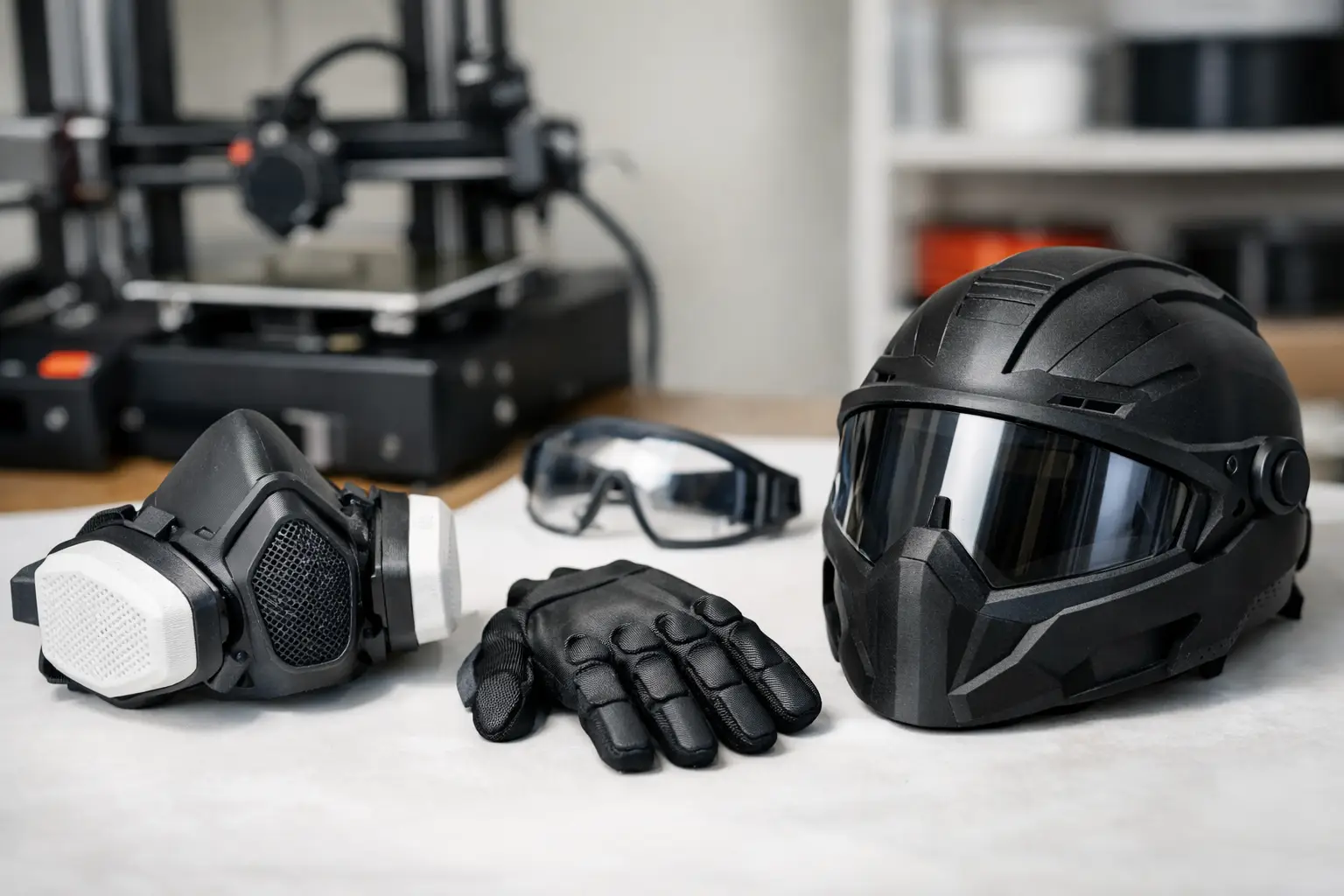
When a medic, responder, or civilian defender is missing a critical piece of gear, the problem is not theoretical. It is immediate. That is where 3d printed protective equipment gets real value – not as a flashy tech story, but as a way to close dangerous supply gaps fast when traditional manufacturing cannot keep pace.
The appeal is easy to understand. A part can be designed, adjusted, printed, and delivered locally in a fraction of the time it might take to tool up a factory or wait for overseas shipping. In high-pressure environments, that speed matters. But speed alone is not enough. Protective equipment sits in a category where failure carries consequences, so the real question is not whether 3D printing is impressive. The real question is where it performs, where it falls short, and how to use it responsibly.
Where 3d printed protective equipment makes sense
Not every item in the protective gear stack should be printed. That distinction matters. The strongest use case for 3d printed protective equipment is often in accessories, adapters, mounts, replacement parts, and custom-fit components that support an existing protection system.
Take face shield frames as an example. During supply disruptions, these became one of the clearest demonstrations of how additive manufacturing could respond quickly. The printed frame itself was not the protective barrier. It was the structure that held the barrier in place. That is a meaningful difference, because it shows where printed parts can solve urgent problems without overpromising on performance.
The same logic applies to helmet accessories, communication mounts, cable guides, equipment brackets, retention clips, and quick-turn field modifications. These parts may not stop a ballistic threat, but they can make mission-critical gear usable, adaptable, and available when standard procurement lags behind reality on the ground.
There is also a strong case for personalized fit. Traditional manufacturing favors standardized sizes. Additive manufacturing makes it easier to produce custom contours for facial structures, limb geometry, or specific equipment layouts. In some scenarios, a better fit improves comfort and wear time. That can translate into better compliance and better readiness.
Where 3d printed protective equipment should be approached carefully
This is where discipline matters more than enthusiasm. There is a difference between a printed accessory and a printed item that claims to protect against impact, heat, fragments, chemicals, or ballistic force.
For high-risk protection, materials, layer adhesion, print orientation, post-processing, and quality control all affect performance. Two parts printed from the same design file may behave differently if one is made on a poorly calibrated machine, with lower-grade filament, or under rushed conditions. That inconsistency is a serious issue when lives are on the line.
A printed knee pad shell, for instance, might be acceptable in a lower-risk support role if properly tested. A printed ballistic plate is another matter entirely. The burden of validation rises sharply as the threat level rises. If an item is expected to absorb energy, resist penetration, maintain integrity under stress, or perform predictably in extreme temperatures, informal production is not enough.
That does not mean additive manufacturing has no role in advanced protection. It means the path from prototype to fielded equipment must be controlled. Serious users need documented testing, repeatable production standards, and clear limits on how the item should be used.
The biggest advantage is speed under pressure
In crisis response, speed changes outcomes. When demand spikes overnight or supply lines break down, conventional production can become a bottleneck. Tooling delays, shipping backlogs, vendor shortages, and procurement friction all slow the arrival of needed gear.
This is where 3D printing earns attention. It allows teams to define a need, source or develop a design, and begin producing units close to the point of use. That shortens the timeline between identifying a problem and getting a workable solution into someone’s hands.
For mission-driven organizations and rapid-response operators, this is not a minor advantage. It is operational leverage. A local print network can produce specialized parts in days instead of weeks. If a component breaks in the field and the original manufacturer cannot deliver quickly, a replacement can sometimes be modeled, tested, and reproduced faster than the traditional supply chain can react.
That said, urgency should never erase judgment. Fast production only helps if the output is dependable. A weak part delivered quickly can create a second failure where there was originally only one.
Materials decide more than most people realize
A lot of public conversation around 3D printing focuses on the machine. In practice, the material often matters more. PLA may be easy to print, but it softens under heat and is usually a poor choice for demanding protective applications. PETG offers better toughness and chemical resistance in some contexts. Nylon can provide durability and flexibility, while advanced composites may increase stiffness or strength depending on the formulation and use case.
But no material solves every problem. A stronger filament may be harder to print consistently. A heat-resistant polymer may require specialized equipment. Composite-filled materials may perform well in one direction and poorly in another depending on print orientation. This is why blanket claims about printed protection should raise concern.
The right material depends on what the part must survive. Impact is different from abrasion. Chemical splash is different from prolonged UV exposure. A mount that works indoors may fail in a vehicle under summer heat. Field conditions are unforgiving, and protective equipment has to be judged there, not just on a workbench.
Testing is the line between innovation and risk
The most responsible conversation about 3d printed protective equipment always comes back to testing. Not assumptions. Not enthusiasm. Testing.
A prototype can look excellent and still fail under stress. A part may survive one impact but crack after repeated use. It may fit well in a clean lab and warp inside a hot vehicle. None of these weaknesses are obvious from appearance alone.
That is why validation should include more than whether a print completed successfully. Serious evaluation means checking dimensional consistency, attachment security, heat tolerance, wear behavior, and performance under realistic load. If the part supports protective gear, it should be tested as part of the full system, not in isolation.
For organizations working in urgent environments, accountability matters as much as innovation. Donors and supporters deserve to know that speed is paired with standards. A fast-moving supply effort gains trust when it can show how equipment needs were identified, how solutions were vetted, and how field performance was monitored after deployment.
What smart deployment looks like
The best use of additive manufacturing is targeted, not careless. It works when teams know exactly what problem they are solving and what level of risk the part carries.
A smart deployment model starts with need definition. What is missing, broken, delayed, or poorly fitted? From there, the next question is whether a printed part is the right answer or only the fastest answer. Those are not always the same thing.
If printing is appropriate, the design must match the mission. Then comes controlled production, inspection, user feedback, and revision. In other words, 3D printing should be treated as part of an operational pipeline, not as a hobbyist shortcut.
This is especially relevant for organizations built around direct impact. A disciplined define, source, deliver approach fits additive manufacturing well because it forces clarity at each stage. The goal is not to print more things. The goal is to solve urgent protection problems with equipment people can trust.
Why this matters beyond the technology
The real story behind 3d printed protective equipment is not the printer. It is resilience. When communities and responders can produce essential components closer to where they are needed, they reduce dependence on slow systems and distant bottlenecks. They gain flexibility. They gain options. In some moments, those options protect lives.
There is also a deeper lesson here for anyone who supports frontline readiness. Innovation is most valuable when it is disciplined by mission. The strongest protective solutions are rarely the most hyped. They are the ones that arrive on time, perform as promised, and hold up under pressure.
That is the standard that should guide every conversation about new protective technologies. Move fast, but verify. Build creatively, but test relentlessly. And when a tool proves it can close dangerous gaps with speed and accountability, use it to protect the people who need it most.