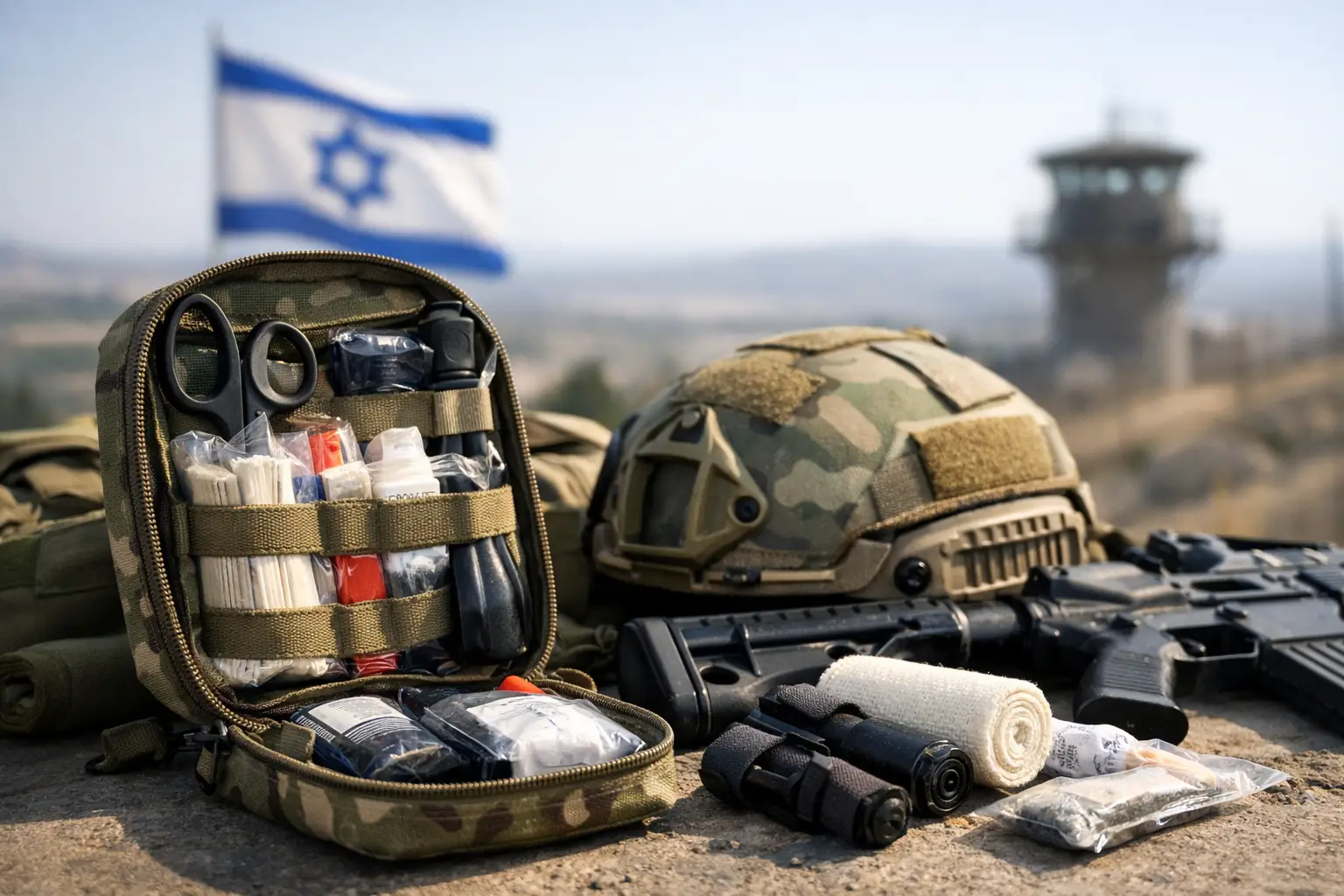
When a defender is hit, the first few minutes decide everything. That is why IFAK kits for Israel defenders are not a side item, a nice-to-have, or a warehouse checkbox. They are immediate trauma response tools built for the harsh reality of frontline injuries, mass-casualty scenes, and attacks where evacuation may be delayed and every second has weight.
For donors and supporters, this matters because an IFAK is not abstract aid. It is a concrete, visible intervention with a direct purpose – stop bleeding, protect the airway, stabilize trauma, and give a wounded person a real chance to survive until higher-level care arrives. In a high-threat environment, the right kit in the right hands is not symbolic support. It is operational support.
What IFAK kits for Israel defenders are really designed to do
An Individual First Aid Kit is not a general first aid pouch. It is a mission-focused trauma kit meant for severe, time-critical injuries. The difference matters. A basic consumer first aid kit handles cuts, burns, and minor incidents. An IFAK is built for hemorrhage control, penetrating trauma, chest wounds, and battlefield-style medical emergencies.
That distinction is often missed by well-meaning donors. People hear “first aid” and imagine bandages and antiseptic wipes. The reality is far more serious. Defenders operating under fire or responding to attacks need tools that address the leading preventable causes of death in trauma, especially massive bleeding. If a kit cannot support those priorities, it may look complete on paper while failing in practice.
A strong IFAK usually centers on proven trauma essentials such as a tourniquet, pressure bandage, hemostatic gauze, chest seals, gloves, and airway support components where appropriate. The exact contents can vary based on mission profile, training level, and operating environment. That is where thoughtful sourcing becomes critical. The goal is not to stuff a pouch with more items. The goal is to provide the right items that can be deployed fast, under stress, by someone who has trained with them.
Why the quality of an IFAK matters under pressure
In normal consumer buying, people compare features. In trauma care, reliability comes first. If a zipper jams, packaging tears poorly, or a tourniquet breaks under real force, the cost is not inconvenience. The cost can be a life.
That is why vetted IFAK kits for Israel defenders should never be treated like commodity products. Quality control matters. Manufacturer credibility matters. Field suitability matters. A compact kit that carries proven components is better than a bulky bag packed with low-trust gear. Under pressure, simplicity wins. Familiarity wins. Durability wins.
There is also a trade-off here. More equipment is not always better. A heavily loaded pouch can slow access and create confusion, especially in low-visibility conditions or when a defender is self-treating one-handed. The best kits balance completeness with speed. They are organized for immediate reach, not for catalog appeal.
Speed changes outcomes
The reason trauma kits matter so much in Israel’s security environment is simple. Threats do not wait for ideal conditions. A defender may be injured during a response in an urban area, on a road, near a civilian community, or in terrain where evacuation is complicated. In those moments, early intervention bridges the gap between injury and advanced care.
That bridge is where lives are either lost or saved.
A tourniquet applied quickly can stop catastrophic bleeding before shock takes over. Chest seals can buy critical time after penetrating trauma. Pressure dressings can slow blood loss long enough for evacuation teams to move. None of this replaces physicians, medics, or hospitals. It extends survival until they can take over.
Supporters who care about measurable impact should pay attention to that timeline. Funding trauma response gear is one of the clearest examples of direct-effect giving. The chain is easy to understand: define the threat, source the correct equipment, deliver it to the people most likely to need it. No vague promise. No institutional haze. Just equipment with a life-saving job.
What separates a serious kit from a symbolic one
A serious IFAK starts with medical purpose, not presentation. It is built around the injuries defenders are most likely to encounter and the interventions they are trained to perform. Every item should justify its place.
That means there is little room for filler. Minor-care items may have some use, but they should never crowd out critical trauma components. Space and weight are limited. A good kit respects that reality. It prioritizes severe bleeding control, wound packing capability, and trauma management basics over nonessential add-ons.
It also needs to be wearable and accessible. A well-equipped kit that is too awkward to carry consistently is less useful than a slightly leaner kit that stays on the person at all times. This is another place where it depends on mission. A rapid responder, a civilian security team member, and a defender in sustained operations may need different configurations. The best support model recognizes those differences instead of pretending one setup fits every role.
Training and equipment have to work together
An IFAK is only as effective as the user’s ability to deploy it. This is not a reason to delay equipping people. It is a reason to connect the right gear with the right training standards.
Some donors assume that if gear is issued, the problem is solved. It is not that simple. Trauma tools have to match what defenders have been taught, what protocols they use, and what medical systems on the ground expect. A great product can still create friction if it conflicts with training or introduces unfamiliar components during a crisis.
That is why disciplined procurement matters so much. The strongest aid efforts do not just buy supplies. They coordinate with units, responders, trusted professionals, and field realities. They ask the practical questions. Who is carrying this? What injuries are most likely? What is the evacuation window? What gear is already standard? Where are the gaps?
That operational mindset is what turns generosity into effectiveness.
Why donors should care about sourcing, not just supplying
There is a real difference between sending gear and solving a problem. In high-stakes environments, rushed sourcing can create waste, inconsistency, or dangerous mismatches. On paper, dozens of kits may look like impact. On the ground, only vetted, relevant, deployable kits create real readiness.
This is where accountable nonprofit action matters. The best humanitarian support works like a high-performance response team. It identifies urgent needs fast, sources proven solutions, and delivers without bureaucratic drag. That is especially important for IFAKs because urgency and specificity both matter. Delayed delivery reduces usefulness. Poorly selected gear reduces trust.
Organizations such as Israel Friends approach this work with the kind of disciplined urgency the moment demands – define, source, deliver. That model resonates because it respects both the donor and the defender. It says your contribution should move quickly, land where it is needed, and produce a visible protective result.
The humanitarian case is clear
Supporting IFAK kits for Israel defenders is not only about military readiness. It is about preserving life in the most immediate sense. Defenders often stand between violent attacks and civilian communities. Giving them the tools to treat life-threatening injuries protects the people who protect others.
There is also a wider human reality behind this. Trauma does not end at the moment of injury. Every survival preserved through rapid care reduces the long shadow of loss for families, teams, and communities. The practical act of placing a trauma kit on a vest or in a vehicle carries moral weight. It says we will not leave people exposed while paperwork catches up.
That directness is why this kind of giving matters to action-oriented supporters. It is specific. It is urgent. It is accountable. You can point to the intervention and understand its purpose immediately.
What meaningful support looks like
Meaningful support starts by rejecting the idea that all aid is equal. It is not. In trauma response, precision matters. A donation tied to vetted medical gear has a different profile from one absorbed into a broad pool with unclear deployment. Supporters who want tangible outcomes should seek efforts that can explain what is being delivered, why it is needed, and how fast it is getting there.
That does not mean every kit is identical or every field condition is predictable. There will always be variables. Supply chains shift. Threat environments change. End-user requirements evolve. But disciplined organizations adjust to those variables instead of hiding behind them.
The real standard is simple. Does the support move at the speed of need? Does it match the operational reality on the ground? Does it put trusted, usable life-saving equipment into the hands of people who may need it at any moment?
If the answer is yes, then the support is not just charitable. It is protective. And in a region where seconds can separate tragedy from survival, protective action is exactly what this moment calls for.
When people ask what effective solidarity looks like, start here: not with slogans, but with tools that stop bleeding, buy time, and help bring someone home alive.