A dark perimeter is not an abstract security concern when civilians, responders, or defenders are depending on early warning. It is a decision point measured in seconds: Can a team see a developing risk, verify what is happening, and act before uncertainty becomes harm? That is where thermal cameras versus drones becomes the right question – not which technology is more impressive, but which one delivers the awareness a specific mission needs.
Both tools can help identify heat signatures in low-light conditions, extend situational awareness, and reduce the need to send people into uncertain environments. But they solve different problems. Treating them as interchangeable can leave a critical gap in coverage, response time, or reliability.
Thermal Cameras Versus Drones: The Core Difference
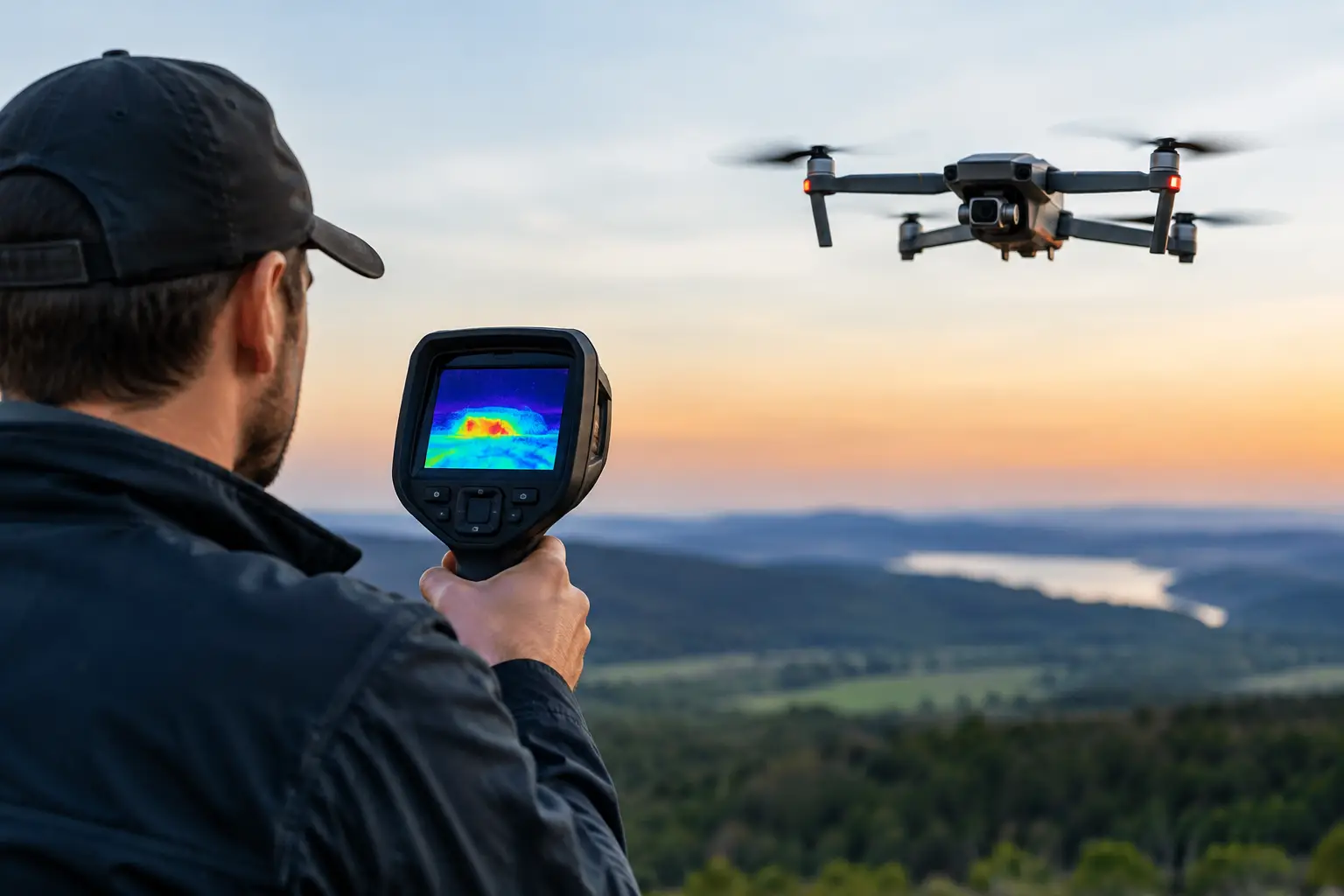
A thermal camera detects differences in heat rather than relying only on visible light. Fixed thermal cameras can monitor a gate, roadway, community boundary, or other defined area around the clock. Handheld and vehicle-mounted thermal systems can help trained personnel assess conditions from a safer distance. Their central strength is persistence: once installed and properly maintained, a camera is ready to watch the same vital area continuously.
A drone is a mobile platform. When equipped with visual or thermal imaging, it can provide an aerial view of an area that fixed equipment cannot fully cover. It can help teams assess changing conditions, examine terrain, or gain perspective after an incident. Its strength is flexibility and reach.
The distinction matters because a fixed thermal camera is built to answer, “What is happening here right now?” A drone is better suited to asking, “What is happening beyond our normal line of sight?” Both questions matter. Neither replaces the other in every circumstance.
When Thermal Cameras Carry the Mission
Thermal cameras are often the practical first layer of protection for locations with known, recurring surveillance needs. A community entrance does not move. A vulnerable stretch of road does not move. A facility perimeter, a staging area, and a public gathering site all need dependable observation long after the initial crisis has left the headlines.
That is where fixed thermal coverage earns its value. It does not need to be launched, piloted, or returned for charging before it begins providing information. A well-matched system can operate through darkness, smoke, haze, and other conditions that make conventional cameras less effective. It can alert trained monitors to movement or anomalies that warrant a closer look.
Thermal imaging is not magic. It cannot identify intent, and a heat signature alone does not explain whether a person, animal, vehicle, or piece of equipment presents a threat. Weather, terrain, image resolution, calibration, and operator training all affect what can be seen and understood. The goal is not to replace judgment. It is to give responsible people better information sooner.
For donors focused on durable impact, this is an important point: thermal cameras can create continuous protective capacity. A single carefully deployed system may strengthen awareness every night, in every low-visibility event, and during every period when a community needs to know more than the human eye can see.
When Drones Create a Critical Advantage
Drones answer the problems that fixed cameras cannot. Conditions change quickly. A flood, fire, evacuation, medical emergency, infrastructure failure, or security incident can develop outside the range of a stationary system. In those moments, a trained drone team may be able to gather an aerial view without exposing responders to unnecessary uncertainty.
The value is not simply altitude. It is speed of assessment. An aerial thermal view can help reveal areas of concern in darkness, identify routes affected by an incident, or help responders understand the scale of a situation before resources are committed. That information can make a response more deliberate, more coordinated, and safer for people on the ground.
Yet drones have real constraints. They rely on trained operators, batteries, launch conditions, maintenance, communications, and legal or operational authorization. Wind, rain, signal limitations, restricted airspace, and equipment availability can reduce their usefulness at the precise moment they are needed. A drone may provide extraordinary visibility for a limited period, but it is not continuous coverage.
That does not weaken the case for drones. It clarifies it. A drone is a rapid-response capability, not a replacement for permanent monitoring. Its impact rises when it is procured with a clear mission, placed with a trained team, and integrated into an established response process.
The Best Answer Is Often a Layered One
The choice between these technologies is frequently framed as an either-or decision because budgets are finite and needs are urgent. But in high-stakes protection, the strongest model is often layered: fixed thermal cameras provide ongoing awareness at known points of concern, while drones provide mobile visibility when events move beyond those points.
Think of it as a disciplined sequence. Persistent systems detect or help verify an issue. A responsible team evaluates the available information. Mobile aerial tools can then provide added context when conditions require a wider view. Human decision-makers remain at the center of every step.
This approach also protects donor dollars from being spent on technology for technology’s sake. The question is not whether a tool looks advanced on a specification sheet. The question is whether it closes a specific operational gap. A camera without reliable monitoring may become expensive hardware. A drone without training, support, and a defined purpose may sit grounded when it is most needed.
How to Decide Where Support Should Go First
A responsible funding decision starts with the environment, not the equipment catalog. If the need is continuous observation of a predictable area, thermal cameras may deliver the most immediate and lasting return. If the need is rapid visibility across changing terrain or a broad incident area, a drone program may be the more urgent priority.
Decision-makers should also consider four practical factors: the size and character of the area needing protection, the availability of trained operators or monitors, the system’s expected use after initial deployment, and the total cost of readiness. That final factor matters. Readiness includes installation, power, maintenance, protective storage, training, replacement parts, and the capacity to act on what the equipment reveals.
The technology must fit the people who will use it. A smaller community may benefit more from dependable, manageable thermal coverage than from a complex aerial program it cannot sustain. A professional response organization with trained personnel and an ongoing need for mobile assessment may gain enormous value from drones. There is no serious one-size-fits-all answer.
Technology Must Lead to Action
Surveillance tools do not protect people by themselves. Their life-saving value comes from the time and options they create for trained people to make safer decisions. Earlier awareness can support evacuation, medical response, communication, verification, and the protection of civilians and defenders. But only if the equipment is reliable, the users are prepared, and the process is clear.
That is why rapid-response support must go beyond procurement. It means defining the need, sourcing vetted equipment, delivering it where it will make a measurable difference, and ensuring the receiving team can sustain it. Israel Friends approaches critical equipment with that operating mindset: action over delay, accountability over vague promises, and direct impact where it matters most.
The right question is never simply, “Which tool is better?” Ask what people need to see, how quickly they need to see it, and what they can do with that information once they have it. Fund the capability that turns uncertainty into time, and time into protection.