
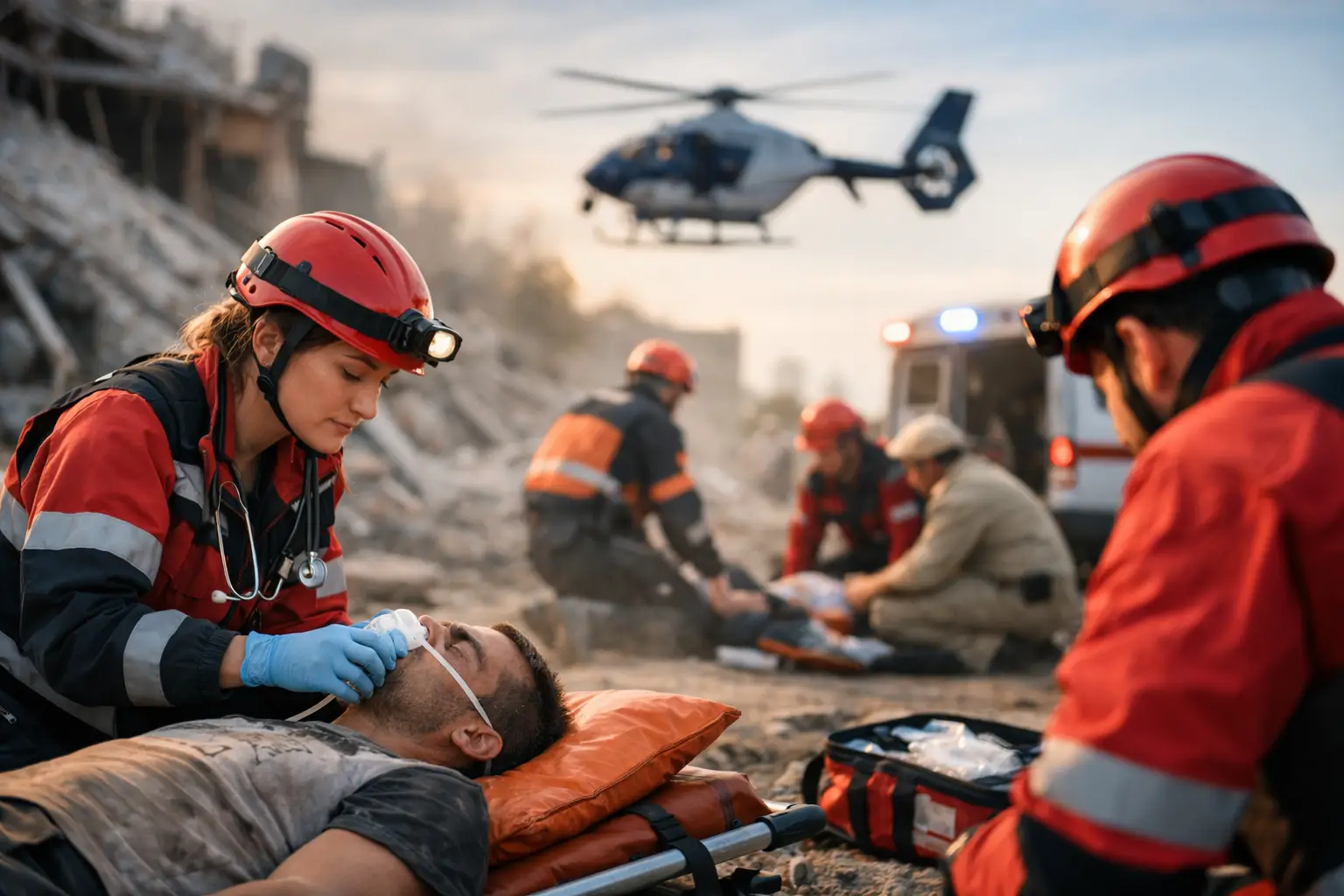
A medic missing tourniquets does not have a logistics problem. A family without safe shelter does not have a paperwork problem. In a crisis, delay becomes danger fast. That is the clearest answer to what is rapid response aid: it is targeted help delivered at the speed the situation demands, not the speed a slow institution can tolerate.
What Is Rapid Response Aid?
Rapid response aid is the immediate delivery of essential support when people face urgent threat, injury, displacement, or trauma. It is built for moments when waiting costs lives, worsens injuries, or leaves civilians and defenders exposed.
That support can take different forms depending on the need on the ground. Sometimes it means trauma kits, protective equipment, or emergency communications tools. Sometimes it means food, temporary shelter, evacuation support, or urgent mental health care after an attack. The defining feature is not the category of aid. It is the timeline, the precision, and the directness of delivery.
Traditional aid models often work through long approval chains, layered procurement, and broad program structures. Those systems can serve a purpose in stable conditions. But during active emergencies, a slower model can become part of the problem. Rapid response aid exists to close the gap between urgent need and real-world delivery.
Why Speed Is the Whole Point
In crisis response, speed is not a branding word. It is an operational standard. The first hours after an attack, natural disaster, or mass casualty event shape what happens next. If responders have the right medical equipment immediately, survival odds change. If communities receive surveillance tools or protective gear before another strike, exposure drops. If trauma support is available early, long-term psychological harm may be reduced.
That said, speed alone is not enough. Fast but careless aid can waste money, duplicate efforts, or send the wrong equipment to the wrong place. Effective rapid response aid combines urgency with discipline. It requires clear needs assessment, trusted sourcing, and direct delivery channels that are already in place before the emergency peaks.
This is where many donors ask the right question: how do you move quickly without losing accountability? The answer is preparation. Strong rapid-response organizations do not invent their systems in the middle of a crisis. They build relationships with local operators, vendors, health agencies, and field partners ahead of time. That preparation is what makes fast action credible instead of chaotic.
What Rapid Response Aid Looks Like in Practice
The phrase can sound broad until you see what it includes. In high-risk environments, rapid response aid often means mission-critical equipment that can be deployed immediately. That might include IFAK kits, helmets, ballistic eyewear, drones, thermal cameras, medical supplies, or surveillance systems for vulnerable communities.
In other situations, the need is less visible but no less urgent. A civilian population under sustained stress may need fast-access PTSD care, telehealth psychiatric treatment, or local resiliency support. Psychological trauma does not always wait for the cameras to leave. Early care matters, especially when fear, shock, and repeated exposure begin to affect daily functioning.
The best response efforts do not force a false choice between physical protection and emotional recovery. They understand that frontline readiness, civilian safety, and trauma care are connected. A secure community still needs healing. A treated patient still needs protection.
The Difference Between Rapid Aid and General Charity
Not every charitable gift is designed for immediate crisis response. General charity often supports long-term programs, broad social services, or flexible institutional budgets. Those efforts can be valuable, but they are not the same as rapid response aid.
Rapid aid is narrower, faster, and more outcome-specific. It starts with an urgent need that can be identified clearly. It moves to a vetted solution that can be sourced quickly. Then it focuses on direct delivery with minimal delay. The standard is simple: what problem must be solved now, and what gets it solved fastest without compromising quality?
This model appeals to donors who want to see exactly where support is going. They are not looking for vague assurances. They want to know whether their contribution helped place trauma kits in the hands of responders, funded psychiatric care for survivors, or equipped a vulnerable area with better monitoring tools. In that sense, rapid response aid is not only about speed. It is also about visibility and measurable impact.
What Makes Rapid Response Aid Effective
Effective rapid response aid depends on a few hard realities. First, the people making decisions must be close to the facts on the ground. Distance creates lag, and lag creates mistakes. Second, procurement has to be agile but disciplined. The cheapest option is not always the right one, and the fastest vendor is not always trustworthy. Third, delivery systems must bypass unnecessary bureaucracy without bypassing oversight.
This is a difficult balance. Move too slowly and the aid loses its purpose. Move too loosely and you risk waste. The strongest organizations solve this by building lean systems with strong controls. They know their partners, understand the terrain, and keep decision-making focused on operational outcomes.
One useful way to think about it is define, source, deliver. Define the urgent need with precision. Source the solution from trusted channels. Deliver it directly where it can do the most good. That sounds simple, but doing it well under pressure is rare.
What Is Rapid Response Aid in a Security Crisis?
In a security crisis, what is rapid response aid if not immediate protection translated into action? It is the bridge between threat and readiness. When defenders and civilians face active danger, support has to be practical, field-tested, and available now.
That can mean protective gear for those on the front lines. It can mean aerial tools that improve visibility and awareness. It can mean emergency medical supplies that shorten the distance between injury and treatment. It can also mean support for families and communities living under the strain of repeated alerts, attacks, or displacement.
There is no single package that fits every emergency. Needs shift by region, by threat level, and by operational capacity. A border community may need one set of tools. An emergency responder unit may need another. A trauma center may need something entirely different. Real rapid response work respects those differences instead of pushing one-size-fits-all solutions.
Why Donors Are Paying Closer Attention
Donors today are more alert to execution. They want to know not just what a nonprofit believes, but how it performs under pressure. That is especially true when lives are at stake and every hour matters.
Supporters are asking tougher questions, and they should. How fast can aid move? Who verifies the need? Are the vendors trusted? Is the impact visible? How much gets lost to overhead or delay? These are not cynical questions. They are responsible ones.
For values-driven supporters, rapid response aid offers a clearer line between giving and outcome. It aligns moral urgency with operational action. That is one reason organizations such as Israel Friends resonate with people who want direct impact rather than institutional drift. They are not looking to fund motion. They want to fund protection, care, and results.
The Trade-Offs and Limits
Rapid response aid is powerful, but it is not magic. It cannot replace long-term recovery, national policy, or full health system capacity. It is strongest in the early and acute phases of crisis, when targeted intervention can stabilize a situation or reduce immediate harm.
There are also trade-offs. Fast deployment may limit how broadly an organization can consult before acting. A focus on urgent needs can leave less room for slower structural work. Equipment delivered quickly still requires training, maintenance, and integration into real operations. Mental health access started in an emergency still needs follow-through.
The most effective rapid response organizations understand that emergency intervention is only the beginning. The goal is not simply to move fast and move on. It is to identify critical gaps, address them immediately, and then work toward sustainable, long-term solutions that outlast the crisis itself.
In many cases, that means partnering with institutions, advocating for policy changes, and encouraging government agencies or healthcare systems to adopt and scale successful solutions. For example, when Israel Friends helped expand access to psychiatric telehealth services through Healthy Mind, the objective was never to remain the permanent provider. By working with Israel’s major health insurance providers, the program helped secure coverage for approximately 80% of treatment costs, creating a pathway for long-term access to care long after the emergency phase had passed. Once sustainable systems are in place, resources can be redirected toward the next urgent need.
That does not weaken the case for rapid response aid. It clarifies what it is for. It is the first decisive move in a larger strategy—one that not only addresses immediate needs but helps ensure those needs remain met for years to come.
Why This Matters More Than Ever
We are living through a period when threats move quickly and public attention moves even faster. Communities can face mass trauma, active violence, and infrastructure strain all at once. In that environment, the old habit of waiting for systems to catch up is not good enough.
Rapid response aid matters because people in danger do not need symbolic concern. They need equipment, care, protection, and recovery support delivered while those things can still change the outcome. When done well, this kind of aid tells vulnerable communities something they need to hear and see at the same time: you are not alone, and help is already moving.
The strongest support does not arrive after the moment has passed. It meets the moment head-on.