A medic reaches a wounded person with only seconds to assess bleeding, protect an airway, call for evacuation, and stay alert to the threat around them. In that moment, the question of what equipment do frontline medics need is not academic. It is a question of whether care can begin immediately, whether the medic can keep moving, and whether a casualty has a real path to survival.
Frontline medicine is not one bag of supplies. It is a layered capability built for chaos: personal trauma treatment, team-level care, protective equipment, evacuation tools, and communications that connect the point of injury to the next level of care. The right equipment depends on mission, terrain, threat level, distance from a hospital, and the medic’s training. But the governing standard is clear: every item must earn its weight by solving a likely problem fast.
The first priority: stopping preventable death
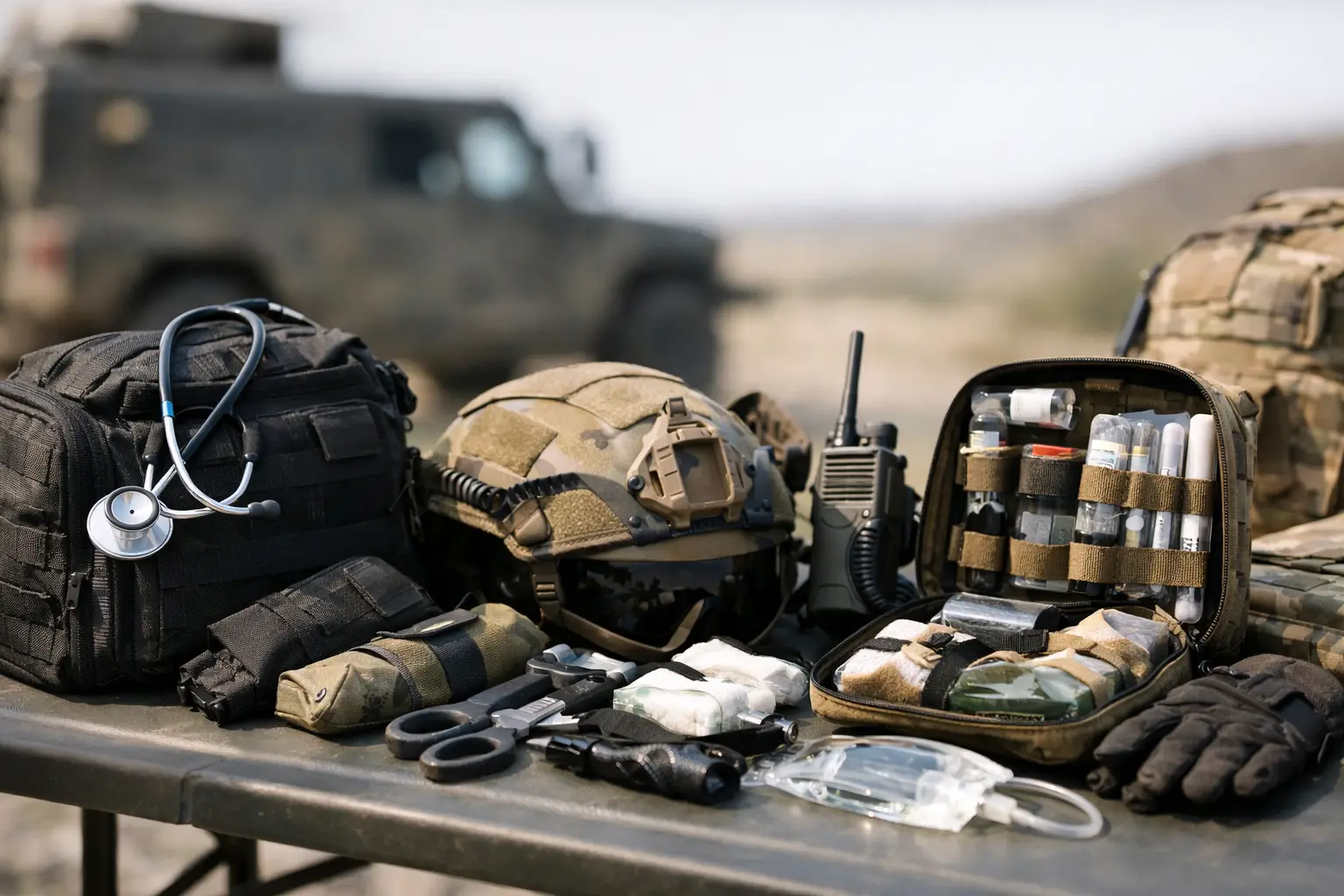
Severe bleeding remains one of the most immediate threats after traumatic injury. That is why an Individual First Aid Kit, or IFAK, is foundational equipment for every trained frontline medic and, in many settings, every operator. An IFAK must be compact enough to carry consistently, organized enough to use under stress, and stocked with quality components rather than generic substitutes.
A mission-ready trauma kit commonly includes tools to control major bleeding, pack deep wounds, cover chest injuries, and support an airway. High-quality tourniquets, hemostatic gauze, compressed gauze, pressure dressings, chest seals, trauma shears, gloves, and a hypothermia blanket are not optional extras. They address the injuries that can worsen in minutes.
The difference is not simply having these supplies nearby. It is placing them where a medic can reach them with either hand, even in darkness, confined spaces, or while wearing body armor. Equipment that is buried, poorly labeled, expired, or unfamiliar can fail just as surely as equipment that was never issued.
IFAKs must match training and mission
More gear is not automatically better. A medic should not be handed advanced airway devices, medication, or invasive tools without the authority, training, protocols, and resupply system required to use them safely. A patrol operating near rapid evacuation may carry a different load than a team working in a remote area under sustained threat.
Standardization matters. When every kit follows the same layout and every team member understands what is inside, medics lose fewer seconds searching and can replenish supplies more reliably after a mission. In crisis response, consistency is a force multiplier.
What equipment do frontline medics need beyond an IFAK?
An IFAK handles immediate individual care, but frontline medics also need a larger aid bag or medical pack for multiple casualties and prolonged treatment. This is where mission planning becomes operationally decisive. A well-built medic bag expands capability without turning the medic into an overloaded supply mule.
The core categories usually include:
- Additional hemorrhage-control supplies for more than one casualty
- Airway and breathing equipment appropriate to the medic’s clinical scope
- Basic assessment tools, including lighting and vital-sign monitoring
- Burn care, splinting materials, eye protection, and wound-management supplies
- Thermal protection, casualty documentation, and limited comfort measures
For teams operating where evacuation may be delayed, the bag may also require extra fluids, medications under medical direction, advanced monitoring, and equipment for longer casualty care. That added capacity comes with a cost: more weight, more complexity, tighter storage requirements, and more training. The goal is not to carry a field hospital. It is to carry the capabilities most likely to bridge a casualty safely to definitive care.
Protection keeps the medic in the fight
A medic cannot treat others if they become the next casualty. Personal protective equipment is therefore medical equipment in the broadest sense. Ballistic helmets, properly fitted body armor, ballistic eyewear, hearing protection, durable gloves, and weather-appropriate clothing all help preserve the medic’s ability to function.
Ballistic eyewear deserves special attention. Eye injuries can take a medic out of action instantly, while dust, debris, wind, and smoke can make careful treatment nearly impossible. Clear vision is essential for assessment, medication labeling, wound care, navigation, and situational awareness.
Protection also includes the practical tools that make care possible after dark. A reliable headlamp with red-light capability, a handheld light, spare batteries, and a way to mark casualties or a treatment point can prevent confusion when visibility collapses. Medical lights should be rugged, simple to operate with gloves, and powerful enough for examination without broadcasting a team’s location unnecessarily.
Evacuation tools turn treatment into survival
The best trauma care cannot replace evacuation. Medics need equipment that allows a casualty to be moved safely, quickly, and with minimal additional injury. Depending on the environment, that may mean soft stretchers, rigid litters, casualty drag devices, straps, blankets, splints, and patient packaging materials.
Weight and terrain matter. A litter that works in an urban building may be difficult to maneuver through brush, rubble, or narrow corridors. A lightweight carry solution may be ideal for rapid extraction but insufficient for a patient who needs more stabilization. Teams should plan for likely evacuation routes before a casualty occurs, not after.
Casualty documentation is another overlooked evacuation tool. A durable card or simple record that captures injuries, interventions, timing, allergies, and known medications gives the receiving team a clearer clinical picture. In a high-pressure handoff, accurate information can prevent duplicated treatment and dangerous gaps in care.
Communications and awareness are life-saving equipment
A frontline medic must know more than what is happening in front of them. Radios, secure communications systems, GPS-enabled devices, maps, and backup power can connect the medic to command, evacuation assets, medical oversight, and nearby teams. When communications fail, treatment and extraction slow down.
Situational awareness tools also protect the entire medical response. Thermal cameras, surveillance systems, and drones can help identify safe approaches, locate people in low visibility, monitor routes, and reduce the risk of sending rescuers into an active threat. These technologies do not replace trained judgment. They give teams better information before committing people and vehicles to a rescue.
Every communications plan needs redundancy. Batteries run down. Signals drop. Devices break. A primary radio without spare power, a backup channel, and agreed procedures is not a complete plan. The same discipline applies to medical equipment: inspect it, test it, replace what is consumed, and train with the exact tools carried in the field.
Readiness is built before the emergency
Equipment saves lives only when it arrives ready. That requires routine inspections, expiration-date checks, inventory control, protected storage, and rapid resupply after use. It also requires scenario-based training. A medic who has practiced finding a tourniquet in darkness, treating a casualty in body armor, or coordinating an evacuation over a disrupted radio network is better prepared to act when the pressure is real.
For donors and communities that want to strengthen frontline readiness, specificity matters. A contribution directed toward vetted IFAKs, ballistic eyewear, evacuation equipment, thermal tools, or trauma-care access produces a visible operational outcome. Israel Friends focuses on identifying those urgent gaps, sourcing trusted solutions, and delivering them where delay can cost lives.
The most meaningful support is not symbolic. It puts proven equipment into trained hands before the next call comes. When a frontline medic reaches a wounded person, that preparation becomes action – fast, focused, and built to protect life.